

Progressive Sanctification is the process of becoming increasingly more like Jesus Christ.
Progressive means that it is a process, not an instant change. It will take a lifetime of learning and it will not be completed until the Day of the Lord, when we will be in heaven with Jesus Christ.
Sanctification is becoming more holy, becoming less sinful, becoming increasingly more like Jesus Himself.
Philippians 1:6. And I am sure of this, that he who began a good work in you will bring it to completion at the day of Jesus Christ.
In his letter to the Philippians, Paul explains that God started a good work in us, and He will bring it to completion, at the day of Jesus Christ. This verse describes the process of sanctification, that it has a beginning and an end. It started the day when God saved us by faith through grace, and it will be completed at the day of Jesus Christ, at His second coming.
1 John 3:2. Beloved, we are God's children now, and what we will be has not yet appeared; but we know that when he appears we shall be like him, because we shall see him as he is.
John describes the same process. We, Christians, are God’s children, because we have been born again, born of the Spirit. And when Jesus appears (His second coming), we shall be like Him. That is when the process will be complete.
Sanctification is frequently described as one of the stages of Salvation, the other two being Justification and Glorification. This is how they are together describing our full salvation:
Justification: to be declared just or righteous. God declares us righteous the moment we put our faith in Jesus Christ. From that moment on, we are born again, born of the Spirit, and all our past, present, and future sins are forgiven. We are forever sure of our salvation because we are sealed by the Holy Spirit for the day of redemption. Whoever is born again cannot become unborn again.
Sanctification: as we described, is the process to become increasingly like Jesus Christ, set apart for God’s glory, becoming increasingly holy, and it starts when we are born again. Just like a baby needs to grow up into maturity, so must we, once we are born of the Spirit, grow into spiritual maturity.
Glorification: upon Christ’s return, we shall be glorified together with Him and live in a restored, sinless, holy perfection forever. We had this glory before the fall in the garden of Eden and through Christ we shall be restored to it.
A fuller exposition of the sanctification process is found in 2 Peter 1:3-15.
2 Peter 1:3. His divine power has granted to us all things that pertain to life and godliness, through the knowledge of him who called us to his own glory and excellence, 4. by which he has granted to us his precious and very great promises, so that through them you may become partakers of the divine nature, having escaped from the corruption that is in the world because of sinful desire.
5. For this very reason, make every effort to supplement your faith with virtue, and virtue with knowledge, 6. and knowledge with self-control, and self-control with steadfastness, and steadfastness with godliness, 7. and godliness with brotherly affection, and brotherly affection with love.
8. For if these qualities are yours and are increasing, they keep you from being ineffective or unfruitful in the knowledge of our Lord Jesus Christ. 9. For whoever lacks these qualities is so nearsighted that he is blind, having forgotten that he was cleansed from his former sins.
10. Therefore, brothers, be all the more diligent to confirm your calling and election, for if you practice these qualities you will never fall. 11. For in this way there will be richly provided for you an entrance into the eternal kingdom of our Lord and Savior Jesus Christ.
12. Therefore I intend always to remind you of these qualities, though you know them and are established in the truth that you have. 13. I think it right, as long as I am in this body, to stir you up by way of reminder, 14. since I know that the putting off of my body will be soon, as our Lord Jesus Christ made clear to me. 15. And I will make every effort so that after my departure you may be able at any time to recall these things.
Please read this text a few times before you continue and see what you can learn about the Progressive Sanctification process from Peter.
First, Peter talks about how God’s power has granted to us all things for life and godliness, through the knowledge of Him. God gave us some incredible promises about us becoming partakers of the divine nature and escaping this world that is corrupted by our sin. This is the end-goal of our Progressive Sanctification, to become like Jesus, having the Spirit of God dwell in us and fully control us.
Next, Peter gives us a very detailed process description of how we will get there. He tells us that we have to make every effort to supplement our faith with some character traits. This means that the beginning of our spiritual growth process is faith. It starts when we are born again, born of the Spirit. It is impossible for us to grow in our Christlikeness if we did not start with faith. So the very first decision that each of us has to make is to put our faith in Jesus. Then we have to supplement that faith with a number of graces or character traits. It may be helpful to briefly define each of them.
Faith: believing is believing the Word of God and acting upon it, no matter how you feel, because God promises a good result. We need faith for salvation and for sanctification.
Virtue: moral excellence, valor, manliness. A desire for things that are right and good combined with an inner determination to do them.
Knowledge: knowing and understanding God, who He is, what He has done and promised, and what He desires, through an increasing experience of Him and His Word.
Self-control: dominion, control, over yourself and your passions, words, thoughts, and actions. Not giving in to impure impulses but being able to control yourself.
Steadfastness: perseverance, endurance, patience, the ability to endure hardships and unfulfilled desires for a long period of time, patiently waiting and trusting in God.
Godliness: living in such a way that pleases God and behaving and responding in Christlike and worshipful ways to the challenges of living in a fallen world.
Brotherly affection: genuine love for your brothers and sisters in Christ, the love and warmth and mutual affection that is to characterize the household of faith.
Love: other-centered, self-sacrificial love for others, a genuine care for them that propels us to do what is best for them, regardless of the costs to ourselves. The capstone of Christlikeness.
While some people see a sequential progression in these traits, most are quick to point out that this is by no means a linear progression. It is indeed not the case that we should have completely mastered the earlier traits before working on some that are mentioned later. Nobody would argue that you should wait with showing brotherly affection and love to others until you have reached full and perfect self-control. But at the same time, we can see how some of the earlier mentioned traits will help us grow in others. For example, a good knowledge of God and His desires for us, will certainly help us to act and become more godly.
The Biblical Counseling Center published the following graph which shows the general progression, which is very helpful.
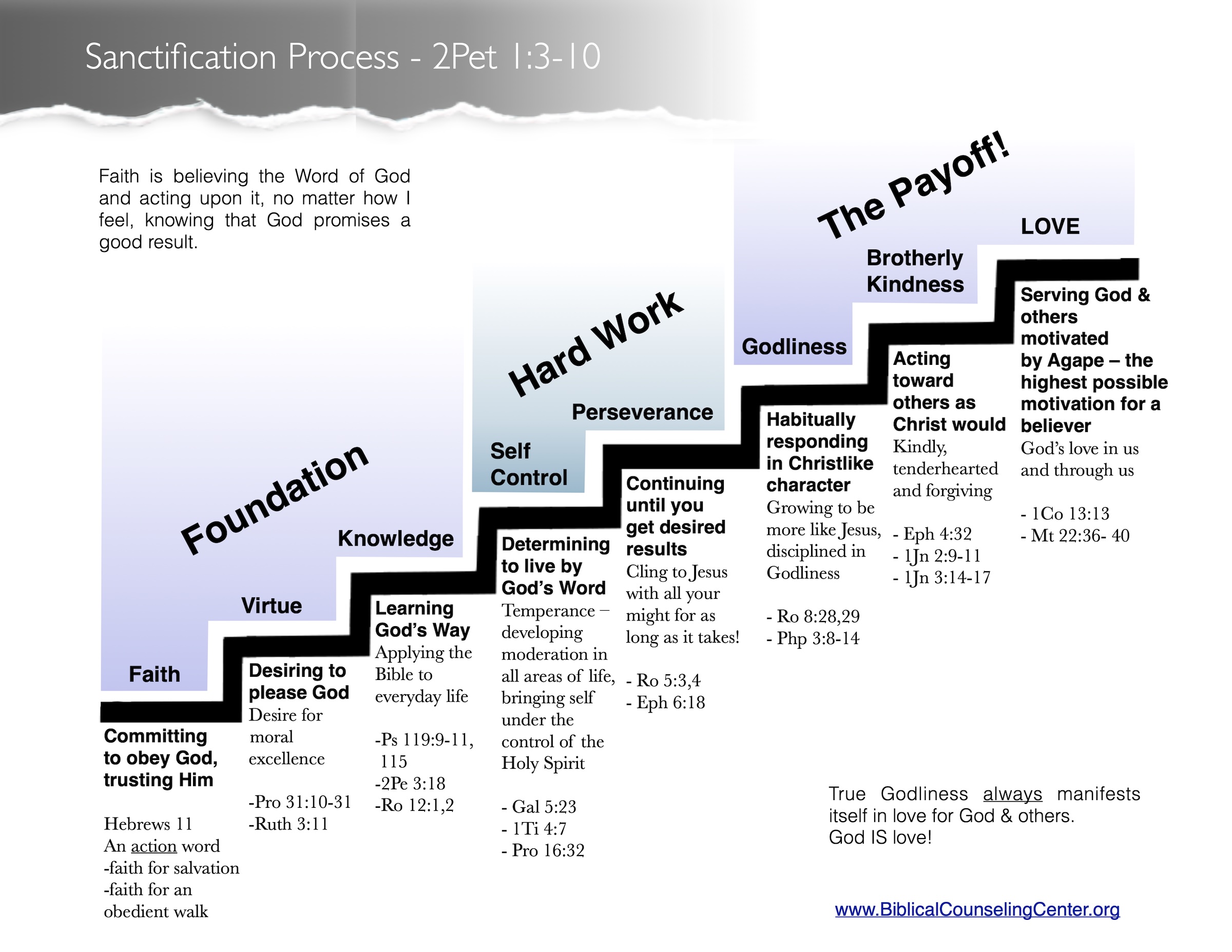
Instead of a linear step model, we could also conceive these as more of a staircase model. As we climb higher on the ladder of progressive sanctification, we keep encountering steps that seem similar to the ones we have been on before, but we are at a higher level.
There are two more observations we can make from the text of 1 Peter.
In verses 8 through 11 Peter tells us that if these qualities are ours and increasing, we will not be unfruitful, but if we lack these qualities we are blind. He then encourages us to be very diligent in doing these things because that is how there will be a lavish reception (BSB) or grand entrance (NLT) for us into God’s eternal kingdom. It appears that the level of our glorification depends on the progress we made in our sanctification.
The final observation is that this progressive sanctification process was incredibly important for Peter. In verses 12 to 15 he mentions three separate times that he wants to remind us of these qualities. He wants to remind us always of them, he wants to stir us up so we do them, and he will make every effort so that after he passed away, we would be reminded of them.
Is Progressive Sanctification that important to you as well? Are you making every effort to grow and become like Jesus? It is hard work, but with God’s grace it is possible, and it will be worth it.
Godspeed!
Comments
Respond to this Post